
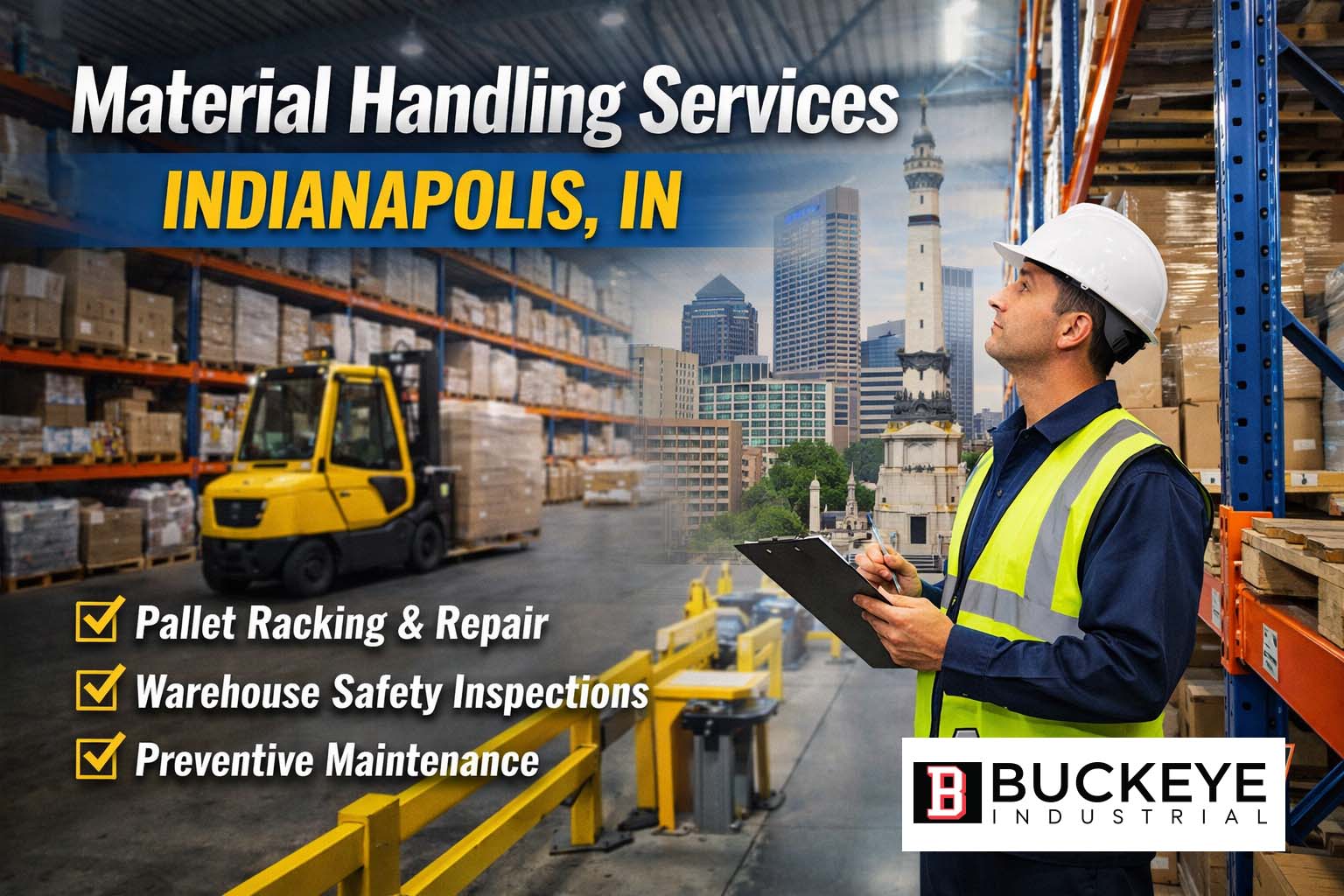
Material Handling Services in Indianapolis IN

Warehouse Safety Inspections in Indianapolis | Rack Safety & OSHA Compliance


Warehouse Safety Inspections in Indianapolis: Why They Matter

Warehouse safety inspections in Indianapolis are one of the most important yet overlooked parts of maintaining a safe, efficient, and compliant facility. With constant forklift traffic, heavy pallet loads, and high inventory turnover, warehouse systems are under continuous stress. Without regular inspections, small issues can quickly turn into serious hazards, costly repairs, or even catastrophic failures.

For distribution centers, manufacturing facilities, and logistics operations across Indianapolis, regular rack inspections and warehouse safety evaluations are essential to protect employees, inventory, and overall operations.


Why Warehouse Safety Inspections Are Critical

Many warehouse issues are not immediately visible. Damage to pallet racking, structural stress, loose components, and improper loading can go unnoticed until they cause major problems. Regular inspections help identify these risks early.

A professional warehouse inspection in Indianapolis can:

  • Identify damaged pallet racking before failure occurs
  • Reduce the risk of workplace injuries
  • Prevent costly inventory loss
  • Improve warehouse organization and efficiency
  • Ensure compliance with OSHA safety guidelines

Common Warehouse Safety Issues Found in Indianapolis Facilities

Warehouses in Indianapolis often experience similar safety issues due to high activity levels and equipment usage. Some of the most common problems include:

  • Bent or damaged pallet rack uprights from forklift impacts
  • Overloaded racking systems exceeding capacity
  • Missing or damaged safety clips and beams
  • Improper pallet placement and uneven weight distribution
  • Lack of rack protection such as guards and barriers
  • Outdated or improperly installed racking systems

These issues may seem minor at first, but over time they can lead to structural failure, downtime, and serious safety risks.


OSHA Compliance and Liability Risks

OSHA requires employers to maintain a safe working environment. While OSHA does not mandate a specific inspection schedule for pallet racking, it does require that equipment be maintained in safe condition.

If a warehouse accident occurs due to neglected maintenance or damaged racking, businesses may face:

  • OSHA fines and violations
  • Increased insurance costs
  • Operational shutdowns
  • Legal liability and lawsuits

Regular warehouse safety inspections in Indianapolis help reduce these risks and demonstrate proactive safety management.


How Often Should You Inspect Warehouse Racking?

The frequency of inspections depends on your warehouse activity level. High-traffic facilities with frequent forklift use should be inspected more often than low-volume storage environments.

Recommended inspection schedule:

  • Daily: Visual checks by warehouse staff
  • Monthly: Internal safety walkthroughs
  • Quarterly: Professional inspection and evaluation

Preventive maintenance programs are one of the most effective ways to ensure inspections happen consistently.


The Cost of Ignoring Warehouse Safety

Ignoring warehouse safety inspections can lead to expensive consequences. A single rack collapse can result in:

  • Product damage or loss
  • Injury to employees
  • Downtime and operational delays
  • Emergency repair costs

In many cases, the cost of prevention is significantly lower than the cost of reacting to a failure.


Warehouse Safety Inspections in Indianapolis: A Proactive Approach

Businesses that prioritize safety inspections are better positioned to maintain efficiency, reduce risk, and extend the life of their warehouse systems. A proactive approach allows you to address small issues before they become major problems.

Buckeye Industrial provides professional warehouse safety inspections in Indianapolis, including rack assessments, safety evaluations, and preventive maintenance programs designed to keep your facility running safely and efficiently.


Request a Warehouse Safety Inspection in Indianapolis

If your facility has not been inspected recently, now is the time to act. Protect your employees, reduce risk, and improve warehouse performance with a professional inspection.


Learn More About Our Indianapolis Services →

Frequently Asked Questions About Warehouse Safety Inspections in Indianapolis

How often should pallet racks be inspected in Indianapolis warehouses?

Warehouse racking should be visually inspected daily, checked internally on a monthly basis, and professionally inspected at least quarterly, especially in high-traffic Indianapolis facilities.

What OSHA requirements apply to warehouse rack safety in Indianapolis facilities?

OSHA requires employers to maintain a safe workplace, which includes ensuring pallet racking and warehouse systems are in safe condition. Regular inspections help meet these safety expectations and reduce liability.

What are the most common warehouse safety issues?

Common issues include damaged pallet rack uprights, missing safety clips, overloaded systems, forklift impact damage, and improper pallet loading.

What happens if damaged racking is not repaired?

Ignoring damaged racking can lead to structural failure, product loss, employee injury, OSHA fines, and costly downtime.

Do you offer warehouse safety inspections in Indianapolis?

Yes, Buckeye Industrial provides professional warehouse safety inspections in Indianapolis, including rack assessments, safety evaluations, and preventive maintenance programs.

Pallet Rack Safety and Inspections Columbus Ohio Central Ohio Free Estimate

Preventive Maintenance for Warehouses: What It Is, How It Works, and Why Quarterly Service Contracts Pay Off

What is Preventive Maintenance (PM)?

Preventive maintenance is a planned, recurring program of inspections, adjustments, lubrication, parts replacement, and safety checks that keeps warehouse and material-handling equipment operating reliably. Instead of waiting for breakdowns, PM finds and fixes small issues before they become big failures that halt production, damage inventory, or create safety risks. In warehousing, PM typically covers pallet racking and shelving, conveyors and sortation, dock equipment and doors, forklifts and reach trucks, mezzanines, safety barriers/guarding, and controls.

Compliance note: OSHA’s warehousing guidance explicitly calls for inspecting and maintaining shelving and racking to prevent collapse, and it emphasizes proper storage and guarding practices—areas PM programs directly address. OSHA+1

How Preventive Maintenance Benefits a Company

  • Cuts unplanned downtime. Industry analyses show unplanned downtime is extremely expensive—ranging from tens of thousands to millions per hour depending on operation scale—making planned maintenance one of the highest-ROI investments available. WorkTrek+2flowfuse.com+2

  • Improves safety and reduces liability. Regular inspections of racks, conveyors, LOTO procedures, and powered industrial trucks reduce injury risk and regulatory exposure. OSHA requires pre-operation forklift inspections and proper guarding/maintenance practices. OSHA+1

  • Extends asset life. Proper lubrication, alignment, tensioning, and timely wear-part replacement add years to equipment life and stabilize capex plans. (Independent studies have reported triple-digit PM ROI.) MicroMain

  • Stabilizes throughput and on-time shipping. Fewer surprise stoppages mean steadier pick/pack SLAs and happier customers.

  • Supports OSHA, insurer, and auditor expectations. Documented PM with corrective actions shows due diligence if an incident occurs. OSHA

What Happens When You Don’t Maintain

  • Rack strikes + hidden damage → collapse risk. OSHA and racking best-practice resources stress routine inspection, impact protection, and prompt repair of damaged uprights/beams. OSHA+1

  • Conveyor incidents. Recent safety bulletins and case write-ups link severe conveyor injuries to lack of guarding, unsafe work practices, or maintenance performed without proper lockout. PM formalizes guarding checks and LOTO verification. WSPS+1

  • Forklift defects. Skipping pre-shift checks and scheduled service raises the odds of leaks, brake failures, chain issues, or tire blowouts. PM and operator inspections work together to catch these early. OSHA

  • What workers say (forums). Maintenance techs in public threads frequently report that chronic under-staffing or deferred PM leads to constant firefighting, more breakdowns, and costlier reactive repairs—confirming the “pay now or pay more later” reality. Reddit+2Reddit+2

How a Quarterly PM Program Works (Buckeye Industrial Model)

1) Baseline survey & risk ranking
We map your process flow, equipment list, age/condition, failure history, and safety hot spots. We rank risks (throughput impact, safety severity, repair cost) and set quarterly task lists.

2) Quarterly service visits (Q1–Q4 cadence)

  • Racking & storage: visual & gauge checks for bent/dented uprights, beam deflection, anchor integrity, load signage, pallet condition; tighten hardware; document damage with photos and tag out unsafe bays.

  • Conveyors & sortation: belt tracking/tension, idlers/rollers, bearings, guards/interlocks, drive chains, gearboxes, motor temps, sensors, e-stops; vibration & noise notes for trending.

  • Dock equipment & doors: hydraulic/air systems, lip & hold-down, door tracks/springs/seals, safety legs/guarding, bumpers.

  • Forklifts & PIT (with your lift vendor or on-site checks): operator pre-op checklist coaching, scheduling 250/500-hr services, tires/brakes/fluids/hoses/chain inspections. OSHA

  • Safeguarding & signage: guardrails, rack protectors, machine guarding, LOTO points, eyewash/extinguishers, posted load charts.

  • Lubrication & wear parts: align with OEM intervals; stage critical spares.

  • Safety & compliance review: findings, corrective actions, and OSHA-aligned documentation. OSHA

3) Reporting & KPIs
You get a digital report each quarter: deficiencies, photos, severity, recommended fixes, quotes, and an updated risk score. KPIs include MTBF, corrective work orders closed, repeat-fault rate, and downtime avoided (hours and estimated cost).

4) Continuous improvement
We trend issues across quarters and propose upgrades (e.g., rack protection, sensor retrofits, belt materials, dock seals) that reduce incidents and energy use.

How Preventive Maintenance Saves Money

  • Avoided downtime: Even modest facilities can lose thousands per hour in labor idle time, missed carrier cutoffs, and chargebacks—PM reduces these events. WorkTrek+1

  • Lower repair costs: Planned part swaps beat emergency service rates and overnight freight for critical components.

  • Extended asset life: Delays large capex by keeping conveyors, racking, and docks in spec. MicroMain

  • Reduced injuries & claims: Guarding checks, LOTO verification, and rack inspections lower incident frequency and severity (and insurer scrutiny). WSPS+1

Who Benefits Most (Industries & Use-Cases)

  • E-commerce & 3PL distribution centers (high conveyor/rack utilization, tight SLAs)

  • Automotive & industrial manufacturing (line-feed sequencing, just-in-time flows)

  • Food & beverage (temperature-controlled docks/doors, sanitation-driven PM)

  • CPG & retail DCs (seasonal volume spikes, mixed storage media)

  • Pharma/healthcare logistics (compliance documentation, chain of custody)

  • Cold storage (door seals, condensation control, corrosion mitigation)

  • Heavy parts & metals (high point loads on racking, forklift impacts)

Why Choose a Quarterly Service Contract with Buckeye Industrial

  • Predictable cost, predictable uptime. Lock in a quarterly cadence, spread your spend, and slash nasty surprises.

  • Local, fast, and specialized. Our teams focus on material-handling environments across Ohio and the Midwest.

  • Compliance-ready documentation. Each visit produces OSHA-aligned reports, photos, and a prioritized action plan. OSHA

  • Scalable scope. Start with racks/conveyors and add docks, guarding, or lifts as you grow.

  • Executive-friendly ROI story. We translate avoided downtime, reduced incidents, and extended asset life into dollars for your CFO—supported by industry data. WorkTrek+1


FAQ (Quick Hits)

How often should racks be inspected?
At minimum annually by a qualified professional, with more frequent in-house checks—monthly or quarterly—where traffic is heavy or damage risk is higher.

Are forklift inspections really required daily?
OSHA requires pre-operation inspections at the start of each shift. A PM program reinforces and documents this. OSHA

Do conveyors need guarding and LOTO checks during PM?
Yes. Several severe injuries have been linked to missing guards or maintenance without proper lockout—two things a solid PM and safety audit will flag.

Preventive Maintenance Services in Central Ohio by Buckeye Industrial

Buckeye Industrial proudly provides comprehensive Preventive Maintenance (PM) services across Central Ohio and surrounding counties, helping businesses in Columbus, Springfield, Dayton, Delaware, Marysville, and beyond keep their warehouse operations running safely and efficiently. Our certified technicians specialize in material handling and industrial equipment maintenance, including pallet racking inspections, conveyor system service, dock and door repairs, forklift safety checks, and guarding assessments. Each PM visit includes detailed OSHA-aligned reports, photo documentation, and actionable recommendations to prevent costly downtime and extend equipment lifespan. Whether you operate a logistics center, manufacturing facility, or distribution warehouse, Buckeye Industrial’s quarterly and annual maintenance programs are tailored to your facility’s unique needs—keeping your operation compliant, productive, and ready for peak demand.

View Our Preventative Maintenance Options

Explore More:


Discover expert strategies for improving environmental protection and safety in everyday operations.

Environmental Protection & Safety in Everyday Operations

Four high-impact upgrades that reduce risk, slash unplanned downtime, and pay for themselves.

Lower defects
Fewer injuries
Energy savings
Insurance–friendly

Environmental Protection & Safety essentials infographic

ESD Control

1) Anti-Static Mats, Flooring & Grounding Tools

ESD is a silent profit leak. Proper anti-static mats and conductive/dissipative flooring move charge away from operators and carts through a safe, high-resistance path to ground, cutting both immediate component failures and latent defects.

Business outcomes

  • Fewer returns & RMAs: lower defect and rework rates
  • Less downtime: fewer mysterious board swaps & intermittent faults
  • Ergonomics: many ESD mats double as anti-fatigue surfaces

Best-practice install

  • Use a common-point ground for mats, heel/wrist straps, and work surfaces
  • Verify resistance-to-ground (Ω) and log audits periodically
  • Bond carts and use conductive casters where practical

Community insight: Technicians consistently report that grounded ESD mats reduce nuisance failures and make ESD audits pass more reliably. Pair them with heel straps or ESD shoes for full-loop protection.

Impact Protection

2) Protective Edge Guards, Bumpers & Corner Posts

Forklifts, pallet jacks, and case carts love corners—unfortunately. Edge guards, rack bumpers, and corner posts absorb impacts before they bend uprights or rupture packaging.

Benefits

  • Prevent structural damage: avoid costly rack repairs and re-inspections
  • Reduce product loss: protect packaging, totes, and cartons
  • Fast install: adhesive, anchor-bolt, or snap-on options

Where to use

  • End-of-aisle uprights, pick modules, and mezzanine posts
  • Shipping/receiving lanes with tight turns
  • Areas with frequent WIP or cart traffic
Cooling Efficiency

3) Airflow Control & Blanking Panels for Racks

Empty U-spaces are sneaky energy wasters. Blanking panels block bypass air so cold supply air is forced through servers, lowering fan speeds and hotspots.

Energy & uptime

  • Lower kWh: reduced cooling load and fan duty cycles
  • Stabilized inlet temps: fewer thermal alarms and throttling
  • Faster deployment: tool-less clip-in installs

Quick checklist

  • Seal all front gaps; keep cable penetrations tidy
  • Maintain hot-aisle/cold-aisle discipline
  • Measure ΔT at inlets/outlets to verify ROI
Fire Safety

4) Fire-Suppression Storage Cabinets for Lithium-Ion Batteries

Li-ion introduces thermal-runaway risk. Fire-rated storage cabinets provide compartmentalization, integrated suppression/venting options, and easier compliance conversations with insurers and AHJs.

Safety & compliance

  • Containment: slows or prevents propagation
  • People & property: distance hazards from egress paths
  • Documentation: spec sheets and labels for inspections

Placement & use

  • Ventilated areas with clear access and signage
  • Segregate charged vs. damaged/isolated packs
  • Train on charging/storage SOPs and incident response

Comparison & ROI Snapshot

Product Primary Benefit Typical ROI Levers Install Notes
ESD mats & grounding Reduce electronic failures & rework Fewer RMAs, higher first-pass yield, less downtime Common-point ground; test resistance to ground
Edge guards & bumpers Prevent impact damage Avoid rack repairs, cut product loss & incidents Adhesive or anchors; protect end-of-aisle uprights
Blanking panels Improve cooling efficiency Lower kWh, extend server life, fewer alarms Seal empty U-spaces; verify with inlet temp logs
Li-ion cabinets Contain fire risk; ease compliance Insurance acceptance, reduced liability & downtime Ventilation, signage, segregate damaged packs

Ask about bundled pricing for combined ESD + guarding + airflow upgrades.

FAQs

Are there real-world examples of these working?

Yes—operators frequently report fewer intermittent failures after implementing grounded ESD mats; facility managers see reduced rack damage where bumpers are installed; and data teams document lower inlet temperatures after sealing racks with blanking panels.

Do I need professional installation?

Edge guards and blanking panels are often DIY. For ESD grounding and Li-ion cabinets, professional install and commissioning are recommended to meet audit and code requirements.

Need spec sheets or an install quote? Contact our team.


Read more about the material handling industry

Emerging Technologies In Material Handling

Emerging Technologies in the Material Handling Space

Revolutionizing Material Handling: The Future of Efficiency

The material handling industry is on the verge of a transformation, driven by cutting-edge technologies like robotics, artificial intelligence, and IoT. From automated guided vehicles (AGVs) that streamline warehouse logistics to AI-powered analytics optimizing inventory management, businesses that adopt these innovations are poised to stay ahead of the competition. Whether you’re looking to reduce costs or enhance operational efficiency, these emerging technologies are reshaping the future of material handling, ensuring faster, smarter, and safer processes. Explore how these advancements can give your business the competitive edge it needs.

1. Robotics and Automation

One of the most significant technological advancements in material handling is the increasing use of robotics and automation. Automated Guided Vehicles (AGVs), Autonomous Mobile Robots (AMRs), and robotic arms are transforming the way goods are transported and managed within warehouses. These robots can efficiently handle repetitive tasks, such as picking, packing, and sorting, without human intervention.

  • AGVs and AMRs: These are now widely used in large distribution centers for transporting goods across the facility. AGVs typically follow set paths, while AMRs are more flexible, using sensors and AI to navigate and avoid obstacles.
  • Robotic Picking Systems: Advanced robotic picking systems can identify and handle different types of products with speed and precision. This technology significantly reduces the need for manual labor and minimizes human error in warehouses, enhancing productivity.

2. Artificial Intelligence (AI) and Machine Learning

AI is reshaping the landscape of material handling services by enabling smarter decision-making and predictive analytics. Machine learning algorithms can analyze massive datasets in real-time, allowing companies to optimize inventory management, predict demand, and streamline logistics operations.

  • Predictive Maintenance: AI-driven predictive maintenance is being used to monitor equipment health in real-time. By predicting when a machine is likely to fail, companies can proactively schedule maintenance, reducing downtime and extending the life of equipment.
  • Demand Forecasting: AI-powered analytics can help forecast demand patterns, enabling businesses to optimize inventory levels and reduce overstock or stockouts, thereby improving operational efficiency.


3. Internet of Things (IoT) and Smart Sensors

The Internet of Things (IoT) plays a crucial role in making warehouses smarter and more efficient. IoT-enabled sensors can provide real-time visibility into the status of goods, equipment, and operations.

  • Asset Tracking: Smart sensors and RFID tags enable real-time tracking of inventory and equipment, providing data that can be used for better inventory management, reducing loss and ensuring that goods are handled correctly.
  • Environmental Monitoring: IoT sensors can monitor environmental conditions such as temperature, humidity, and vibrations to ensure sensitive materials are stored and transported under optimal conditions.

4. Warehouse Management Systems (WMS)

A Warehouse Management System (WMS) is a software solution that helps businesses manage their warehouse operations more efficiently. Modern WMS solutions integrate seamlessly with other systems, such as Enterprise Resource Planning (ERP) software, to provide end-to-end visibility and control over inventory, order fulfillment, and labor management.

  • Real-Time Data Integration: Modern WMS solutions offer real-time data analytics and reporting, enabling warehouse managers to make informed decisions quickly.
  • Automation Integration: Advanced WMS systems can integrate with automation technologies like robotics, AGVs, and conveyor systems, optimizing the flow of goods and reducing labor costs.

5. Augmented Reality (AR) and Virtual Reality (VR)

AR and VR technologies are emerging as useful tools in material handling, particularly in training and operational efficiency. These technologies are increasingly being used in warehouse management for tasks such as inventory picking and worker training.

  • AR in Picking: AR glasses or handheld devices can guide workers through the warehouse, showing them the exact location of products and providing real-time instructions, reducing picking errors.
  • VR for Training: Virtual reality can simulate warehouse environments, enabling workers to practice tasks like forklift driving or machine operation in a safe and controlled environment before handling actual equipment.


6. Drones and Aerial Systems

Drones are being adopted for a variety of tasks in material handling, particularly for inventory management in large warehouses and distribution centers. They can be equipped with sensors and cameras to scan barcodes and RFID tags, making inventory checks faster and more accurate.

  • Inventory Management: Drones can quickly navigate large warehouses to scan inventory, saving significant time and labor costs.
  • Surveillance and Monitoring: Drones are also being used for facility surveillance, ensuring security and safety in large warehouse spaces.

Conclusion

The material handling industry is evolving rapidly with the adoption of emerging technologies. From robotics and AI to IoT and drones, these innovations are helping companies improve efficiency, reduce costs, and enhance safety. As these technologies continue to advance, businesses that invest in them will be better positioned to meet the demands of a fast-paced and ever-changing market.

For companies looking to stay competitive, now is the time to explore these cutting-edge solutions and integrate them into their material handling operations.


Browse Quantum Storage Products

Learn More About Material Handling Products


Explore More: